Address
No. 85, Wuhe Avenue, Longgang District, Shenzhen, China
Working hours
Monday to Friday 10:00 AM - 6:00 PM
Address
No. 85, Wuhe Avenue, Longgang District, Shenzhen, China
Working hours
Monday to Friday 10:00 AM - 6:00 PM
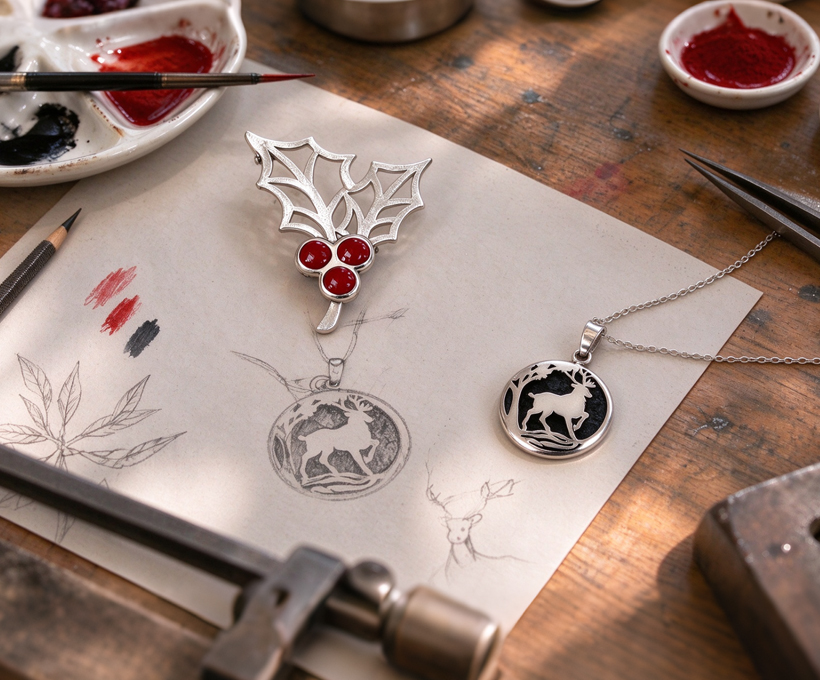
At a time in life when many things demand attention, time and energy have become precious. With little room to focus on new designs for now, I have found an unexpected opportunity to revisit old sketches and earlier works that have quietly accumulated over the years. Some experiences were never properly recorded at the time; I was simply focused on bringing each piece to completion.
I first began learning metalwork because I wanted to extend my experience in visual design into the physical world, turning ideas in my mind into objects that could be held and worn. Lines and forms on paper could be refined through repeated consideration until they came close to what I envisioned. But once a design was translated into metal, much had to be learned from the beginning. Metal has its own qualities of strength and malleability, while handcraft comes with practical limitations. A shape that appears simple on paper does not always translate into metal exactly as imagined.
It took several years to learn metalworking from scratch. Melting silver, annealing, rolling sheet metal, sawing, filing, soldering and polishing — I gradually became familiar with each stage of the process before beginning to understand how to bring a design into reality. Some ideas came together relatively smoothly; others had to be reconsidered and rebuilt from a different direction.
As the Deer was one of my earlier works that left me particularly satisfied. From the initial graphic design to the adjustments made during fabrication, the process unfolded relatively smoothly, and much of the original imagery remained intact in the finished piece. Peace Dove, by contrast, went through several rounds of revision before reaching its final form. One brought the satisfaction of seeing an idea take shape as intended; the other taught me that letting go of an established approach can sometimes lead to a more fitting expression. Knowing when to loosen one’s attachment to an original idea can open the way to something better.
When making the Covenant rings, much of my attention went into studying Hebrew and exploring its written forms. After comparing different references, I chose a natural, flowing handwritten style. The lettering was not merely a means of conveying meaning; it also needed to follow the contours of the rings and become part of their design, allowing form and meaning to complement one another.
As my metalworking skills developed, the possibilities of silver alone no longer seemed sufficient for everything I wanted to explore. Vitreous enamel entered the picture, offering a rich range of colours, enduring material qualities and a distinctive surface that could only emerge through firing. I was drawn to the lustre and texture of the fired glass-based enamel, as well as the many ways it could be used in design. With suitable materials and appropriate firing conditions, vitreous enamel can form a stable, lustrous coloured surface, bringing a visual dimension to silver jewellery that differs from the metal itself.
My preference for unplated 925 sterling silver comes from an appreciation of the material in its own right. Silver has a gentle, natural lustre, but it also gradually tarnishes through exposure to air, sulphur-containing substances and everyday wear, developing marks and variations in tone. The traces of time and fine surface wear are part of the material’s honest character. Leaving the silver in its natural state means not insisting that its surface remain permanently bright, while also avoiding some of the additional steps involved in plating.
The combination of silver and enamel gradually became a direction for JR-workshop to explore. Metal lines establish the structure, while enamel colours introduce depth and layers. Silver can stand on its own, or recede into the background; enamel can serve as a small accent, or take the lead in the overall composition. How the two are combined depends on the intention behind each design, rather than on a desire to incorporate a particular technique for its own sake.
It was only through hands-on experimentation that I began to understand how much more complex enamel work was than I had imagined. The finished piece often differs from the original design. During the making of Holly Berry, for example, the red enamel berries appeared to be no more than simple touches of colour, yet achieving the desired result took considerable effort. With the particular enamel materials I was using at the time, the colour proved sensitive to changes in firing conditions. Even a small deviation could produce a result that fell short of expectations, sometimes leaving the colour looking noticeably darker. What had seemed like a straightforward decorative detail turned out to require repeated trials before I could gradually find a suitable approach.
Bird of Hope presented a different kind of challenge. Its three-dimensional sculptural form made applying and firing the enamel more difficult, and the enamel layer cracked both during the making process and after completion. Differences in thermal expansion between the enamel and its metal base, the structure of the piece and the specific firing conditions can all affect the final result. Even with some experience behind me, a suitable solution was not always immediately apparent. The repeated adjustments were certainly frustrating, but they also reminded me how much there was still to investigate and improve.
I gradually came to understand that learning a craft involves more than mastering a set of techniques. It also means understanding how materials behave under different conditions. Whether a design can be realised as intended must ultimately be tested through making. Even when a problem remains unresolved for a time, the process of adjustment can lead to a fresh understanding of the boundaries between design and craftsmanship.
At JR-workshop, the aim is not simply to reproduce images or to treat technical complexity as the sole measure of a piece’s value. What matters is how form, material and technique work together, allowing a finished piece to retain the intention behind the original design while respecting the practical realities of making it.
From my early days in metalworking to my later exploration of vitreous enamel, this journey has never had a predetermined destination. Understanding has accumulated gradually through practice: sometimes through a piece that comes together as hoped, and sometimes through answers found only after repeated revisions. Rather than rushing to learn as many techniques as possible, I would rather take the time to understand the particular qualities of each material and process, then consider what new possibilities they might offer.
Looking back, the many small lessons gathered through everyday making have quietly shaped JR-workshop’s own creative language. Beginning with design, I continue to explore how the qualities of metal and the colours of enamel can each find their place, and how a balance between them might emerge. In the articles to come, I hope to share more about the characteristics of different techniques and how they can become part of the creative process. This is both a look back at the journey so far and an ongoing record of learning.
After all, handcraft is never something mastered once and for all. Every firing, every strike of the hammer, brings a new conversation with the material.
💝 Warm Moments | Share with Us
Looking back on our creative work, some pieces take shape through repeated adjustments, while others come remarkably close to the original idea from the very beginning.
Have you ever experienced something similar — when a simple idea gradually becomes something quite different once you begin working with it?
I’d love to hear your story. Sometimes, the unexpected turns along the way become the parts we remember most.