Address
No. 85, Wuhe Avenue, Longgang District, Shenzhen, China
Working hours
Monday to Friday 10:00 AM - 6:00 PM
Address
No. 85, Wuhe Avenue, Longgang District, Shenzhen, China
Working hours
Monday to Friday 10:00 AM - 6:00 PM
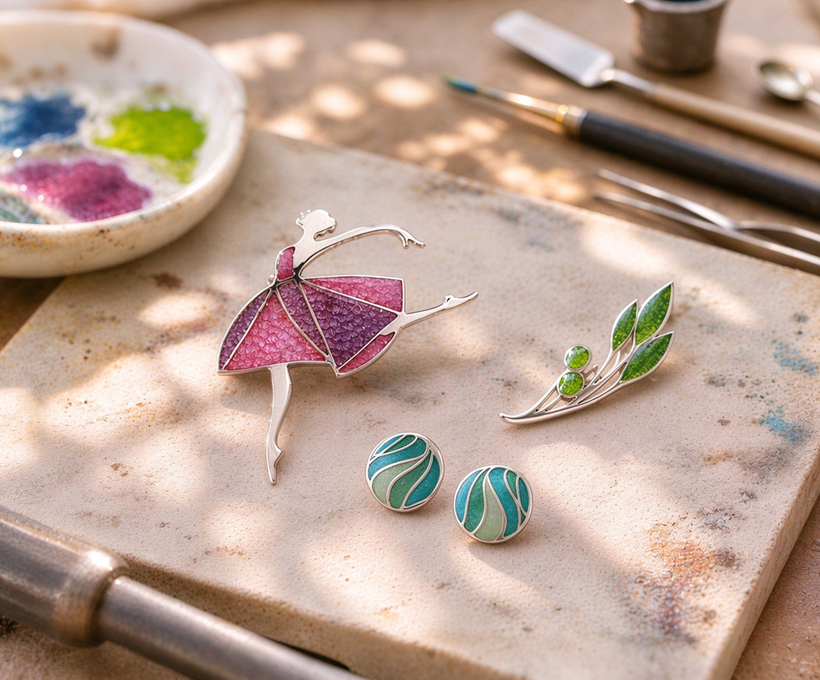
If the beauty of bare silver lies in the subtle play of light across its form and surface, then adding a touch of colour is a way of bringing another point of interest to its quiet elegance. It was this simple thought that gradually led me into the world of vitreous enamelling.
Champlevé enamel is a technique in which recessed areas are created in a metal surface, filled with vitreous enamel and then fired in a kiln to form colour. Unlike Cloisonné, where thin metal wires divide the surface into separate areas for different colours, Champlevé relies on the metal itself to define these boundaries. In Cloisonné, the wires are added to create divisions; in Champlevé, the recessed areas and raised metal outlines work together to shape the composition.
From a design perspective, the silver structure in Champlevé does more than define the overall form of a piece. It also plays an active role in organising its patterns and colours. The recessed areas provide defined spaces for the enamel, while the surrounding bare silver retains its natural character and lends definition to the colours. The enamel brings warmth, brightness or a sense of quiet depth, while the silver preserves the structure through its lines, contours and open spaces. The two complement and balance one another, together shaping the final character of the piece.
This relationship also brings more details to consider during the design process. The depth and width of each recess, the arrangement of the silver lines, the proportions between coloured sections, and the placement of colour within the overall composition all require careful thought. A technique does not make a design successful on its own. It simply offers another way to express an idea; how it is used must always return to what the piece is intended to convey.
At the same time, materials and techniques each have their limitations. During high-temperature firing, 925 sterling silver is affected by factors such as temperature, exposure time and repeated heating. With successive firings, the silver may soften, become distorted or develop surface oxidation. The depth of the recesses, the thickness of the silver, and the stability of the overall structure all need to be considered from the beginning. Particularly when several rounds of enamel application and firing are needed to achieve the desired result, maintaining the integrity of the silver while realising the original design becomes an important part of the process.
These less visible challenges rarely appear on the initial design drawing. They only begin to reveal themselves once the actual making starts. Lines on paper can extend freely, but when they meet silver and enamel, every detail needs to be reconsidered.
Green Olive was one of my earlier and relatively straightforward explorations of this technique. Silver lines outline the leaves and fruits, while different shades of green fill the recessed areas to distinguish their forms. Green and silver naturally complement one another, creating a calm and gentle impression. Much of the attention went into finding subtle variations within the same colour family, allowing the leaves and olives to retain their own definition while remaining harmonious as a whole.
More recently, Still Waters Run Deep and Dancing Moments have explored two different approaches to colour.
Still Waters Run Deep, on the other hand, embraces cooler tones that sit naturally alongside the character of silver. The enamel follows the structure prepared within the silver, allowing the metal lines and colours to complement one another without competing for attention. The result is a quiet and understated expression.
Dancing Moments uses shades of pink and pinkish purple to depict the light, flowing movement of a dancer’s skirt. Compared with the naturally cool character of silver, warm-coloured enamels require more careful adjustment to achieve the brightness and clarity I have in mind. The thickness of the enamel layer, firing temperature and condition of the piece when it enters the kiln all influence the final result. The pink that appears so light and effortless in the original design gradually takes shape through repeated testing and adjustment in the heat of the kiln.
Warm and cool, these two pieces remind me that there is no fixed hierarchy between silver and colour. Sometimes, colour needs the support of a well-defined structure; at other times, the metal lines should take a step back, allowing the colour more room to express itself.
Choosing a technique has never been about deciding on a particular process first and then finding a design to fit it. It begins with returning to the piece itself, considering what it is meant to express, and then finding the making approach that best serves that intention.
In enamel work, there are always details between the initial drawing and the finished piece that cannot be fully anticipated. Colours and forms can be planned on paper, but the way enamel responds to heat and how silver behaves during firing are things that can only be understood through repeated testing and refinement. That sense of balance develops gradually, through practice and experience.
Perhaps the meaning of exploring different techniques does not lie in adding as many processes as possible, but in gradually understanding the nature of each material and finding a more appropriate way to work with it. In this way, the original design can slowly take shape and become something real.
💝 Warm Moments | Share with Us
When you look at a piece of enamel jewellery, what usually catches your eye first: the colour itself, or the silver lines that frame and define it?
I’d love to hear your thoughts in the comments. A different pair of eyes can often reveal details in the same piece that we might otherwise overlook.